
Systemic business constellations · Team mapping
Business constellations for teams and organizations
When a team is working but not moving forward, the reason is rarely on the surface. Team mapping makes hidden team and organizational dynamics visible and gives leadership more clarity for decision-making.

Do you recognize this?
Situations where the system speaks louder than the chart
When this happens, the issue is often not in individuals. It is in the system of relationships, roles and unspoken rules that the organization chart does not show.
What team mapping reveals
6 pillars of team clarity
Every organization has a visible structure and an invisible dynamic. Team mapping shows where the system is losing power, trust or direction.
Roles and responsibilities
Who has their place and who carries which responsibility?When roles are unclear, people take on too much, too little or the wrong work. A constellation shows where responsibility overlaps, withdraws or remains without an owner.
Relationships and connections
Where does collaboration flow, and where does it break?Tension, silence and avoidance often say more than meetings. Team mapping reveals which connections need more clarity, recognition or boundaries.
Purpose and direction
Is the team truly moving toward the same goal?When everyone reads priorities differently, energy disperses. The spatial map shows what supports shared direction and what unconsciously pulls it apart.
Power and decision-making
Where do decisions get stuck or lose influence?Formal power is not always where real influence sits. A constellation shows who decides, who waits and where the system needs clearer authority.
Culture and trust
What can people say, and what remains unsaid?Trust shows itself in how safe it is to speak the truth. Team mapping highlights unspoken rules, loyalties and fears that shape team behavior.
Results and workflow
Where does the system support results, and where does it block them?Effectiveness is not only a process issue. It often depends on whether people, roles, relationships and direction are aligned enough for work to flow.
What business constellations are
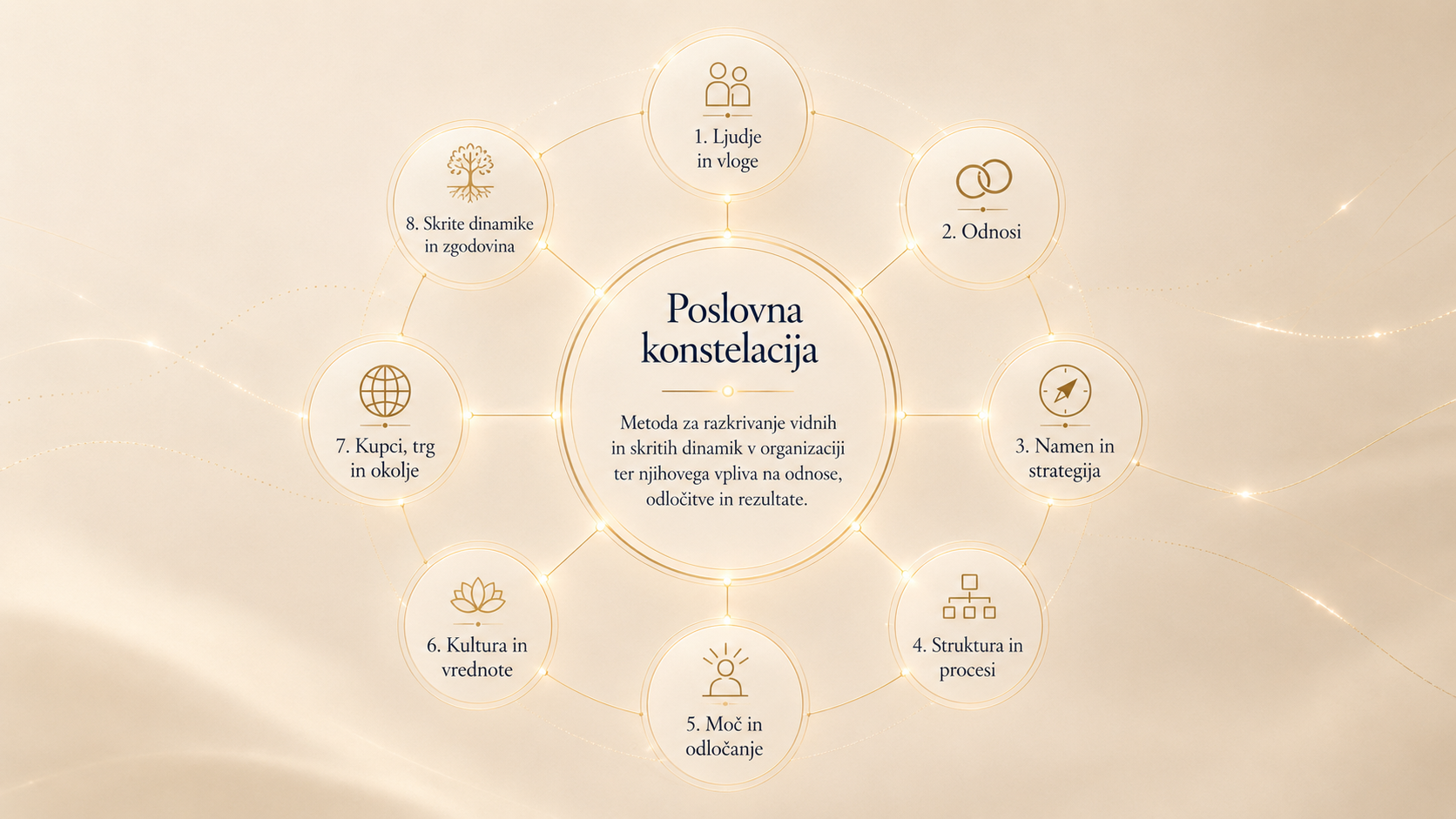
We place relationships, roles and dynamics into space.
Business constellations, also called organizational or systemic constellations for companies, are a structured method for mapping relationships, roles and dynamics in a team or organization.
Elements of the system are represented with figures on a table or with people in the room. What is usually hidden in atmosphere, silence and repeated patterns becomes visible and easier to work with.
We do not look for someone to blame. We look for what keeps the problem alive in the system and what can release it.
The experience in space
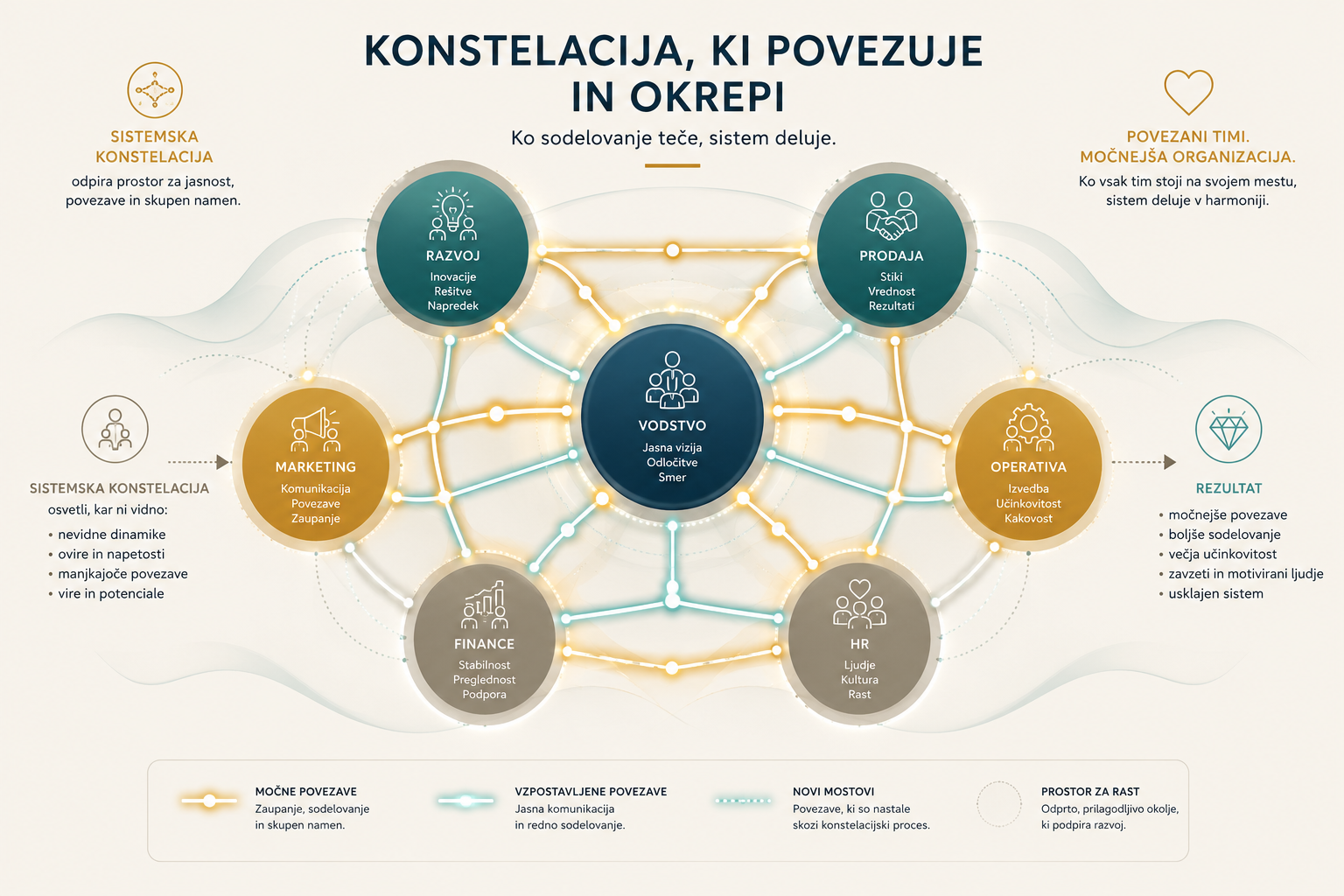
When dynamics become visible, decisions become clearer.
The map helps leadership see where an element of the system needs to move, which relationship needs attention and what the next responsible step may be.
Theoretical background
From family systems to leadership teams
Origin
The method is rooted in Bert Hellinger's systemic constellations and the observation that systems develop symptoms when their implicit rules are disrupted.
Business context
In organizations, constellations focus on business structure and relationships: leadership, employees, departments, market, customers and ownership.
Systemic team coaching
John Whittington developed the approach for leaders and teams, emphasizing belonging, place, time and balanced exchange.
At Spiriton, team mapping is used as a diagnostic and decision-support method that complements structured leadership and team development work.
How it works
From question to concrete next steps
- Introductory conversationWe define the question and check whether a constellation is the right approach.
- MappingWe place the elements of the system into space, individually with a leader or together with a team.
- InsightsDynamics, blocks and overlooked elements that keep the current situation in place become visible.
- StepsInsights are translated into decisions and agreements: who does what and by when.
- Follow-upWe check effects and define further steps when needed.
Typical questions
When leadership teams choose business constellations
- Reorganization, merger of teams or departments.
- Change that meets quiet but persistent resistance.
- Leadership transition and succession.
- Conflicts or blocks in the leadership team.
- Sales that do not move despite good products, processes and people.
- A new role or new leader that does not come alive.
- Testing the impact of an important decision before implementation.
- High turnover or silent disengagement of key people.
What you gain
Less guessing. More clarity.
A clear view of the system, not only of the organization chart.
Why something repeats and what keeps it in place.
Insights become agreements, deadlines and responsibilities.
Responsibility returns to the right place in the system.
From constellation to team transformation
Four formats
Individual
A business constellation for a leader, owner or board member seeking clarity around a specific decision or dilemma.
Team constellation
Team mapping with a leadership team or team that is stuck, creating a shared view and agreed next steps.
Systemic team coaching
A longer team transformation process combining constellations, structured team coaching, role work and measurable agreements.
Team intervention
A focused intervention for acute blocks: leadership conflict, stalled change or a crisis of trust.

Who facilitates the process
Irena Grofelnik, EMBA
The process is facilitated by a systemic facilitator and leadership consultant who has worked for years with leadership and sales teams where results are not a question of knowledge, but of dynamics no one says out loud.
Clarity before comfort. Responsibility before harmony.FAQ
Short answers for leaders seeking clarity
What are business constellations?
A structured systemic method where relationships, roles, goals and dynamics are placed into space so hidden patterns become visible and useful for decision-making.
When is team mapping suitable?
It is suitable for reorganizations, repeated conflicts, resistance to change, leadership transitions, high turnover or testing a major decision.
How long does it take?
An individual session usually takes 90 to 120 minutes. A team session usually takes half a day.
Can it be done online?
Yes. Team mapping can be delivered in person or online, depending on the topic, confidentiality and team availability.

GDPR and cookies
Privacy and website use
Personal data
Data submitted through the contact form, email or phone is used only to respond to your inquiry and prepare an agreement. We do not use it for mass marketing or share it with third parties.
Cookies
The site uses only a necessary local record to remember your cookie notice choice. It does not use analytics, advertising or tracking cookies.
Controller
SPIRITON d.o.o., Ulica Nikola Tesla 18, 1230 Domžale, Slovenia. For privacy questions, write to team@team-mapping.si.